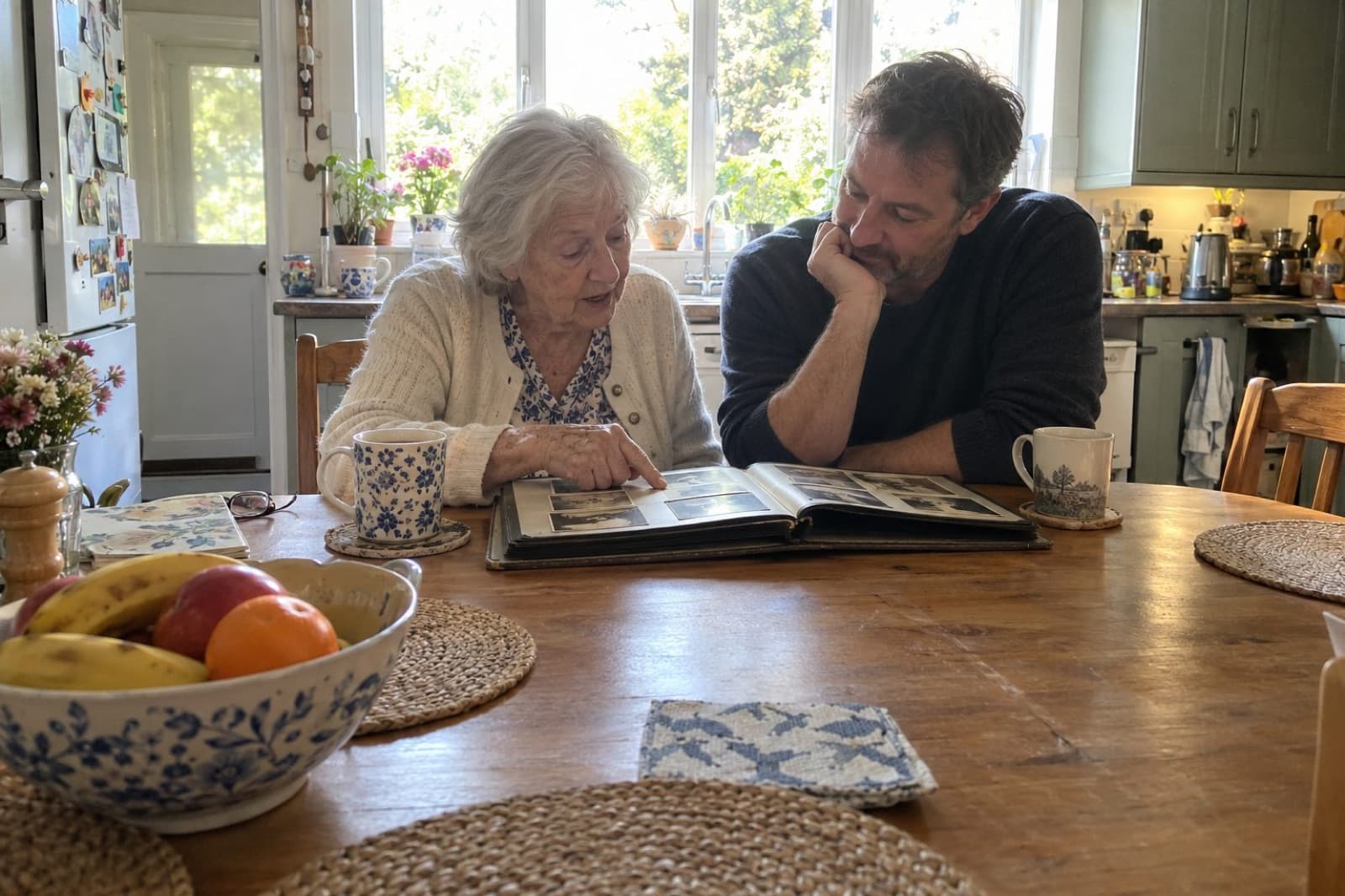
You can begin recording your parents’ life story with one conversation. Choose a comfortable moment, ask what they would enjoy talking about and make a short test recording before you start.
You do not need to cover every year or collect a perfect account in one sitting. A clear recording of someone describing their childhood home can be a worthwhile beginning. This guide takes you through preparing, recording and looking after that first conversation.
Agree what you are making
Before choosing equipment, explain the idea.
“I’d love to hear more about the places you grew up. Would you like to talk for a little while, and would you be comfortable if I recorded it?”
Explain who you hope will hear the recording. Keeping it for yourself, sharing it with siblings and putting it online are different decisions. Agree on the intended audience, and check again before sharing more widely.
If your parent would enjoy talking but would rather not be recorded, you can still have the conversation. Ask whether they would mind you making a few notes afterwards.
A recording should feel like something you are making together.
Choose audio or video
Audio lets you concentrate on the conversation without thinking about how you look. It is a good starting point if being on camera would feel distracting.
Video captures expressions and gestures as well as words. It can be useful if someone wants to show an object or describe a photograph while holding it. It also gives you more to think about: framing, light, storage and whether both people are comfortable on screen.
Ask which feels easier. A relaxed audio conversation is a sensible choice even when you have a camera available.
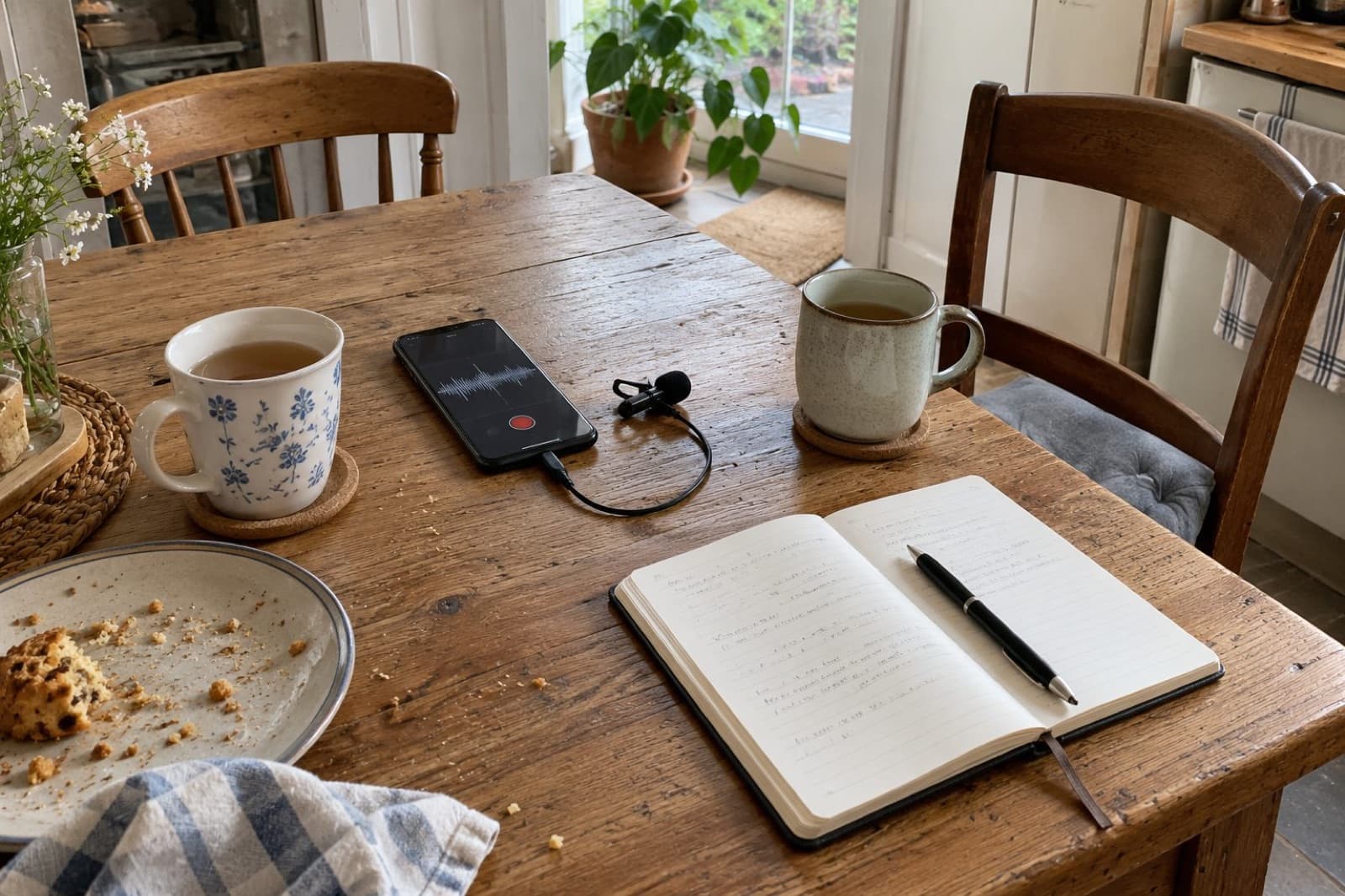
If you already have a phone with a recording app, test it before buying equipment. The important first question is whether you can clearly hear both voices.
Find a quiet, comfortable place
Sit somewhere your parent knows and enjoys. Soft furnishings can help make a room sound less echoey than a bare kitchen.
Listen for sounds you usually ignore: a fan, television, fridge, traffic or music in another room. Where practical, turn off or move away from the distracting source.
Put the phone or recorder on a stable surface near enough to pick up both people. Keep its microphone uncovered. Avoid touching the table or moving papers directly beside it while someone is speaking.
If you use video, place the camera at a comfortable height and avoid a bright window directly behind the speaker. The picture does not need to be elaborate. You should be able to see the person clearly without spending the conversation adjusting the camera.
Make a test you actually listen to
Record half a minute of ordinary conversation. Ask your parent to speak at their usual volume, then speak yourself.
Stop and play it back. Listen for:
- whether both voices are clear;
- whether one person sounds much further away;
- background noise that makes words difficult to hear;
- rustling, tapping or harsh distortion.
Move the device or change the room if needed, and test again.
Check battery life and available storage. Make sure you understand how to stop, save, find and export the recording. A successful test includes finding the saved file afterwards.
The Smithsonian’s oral-history guidance likewise recommends checking the room and testing the recorder for both speakers before the interview. Smithsonian recording guidance
Choose one starting point
Take a few questions, rather than a long questionnaire. You might begin with:
- What is the first home you remember?
- Who did you spend time with after school?
- What do you remember about your first day at work?
- Is there a photograph you would like to tell me about?
Pick one you are curious about. If your parent mentions a detail you do not understand, follow it.
For example, if they mention working above a shop, you could ask what kind of shop it was or how they got there each morning. This is an illustrative example: the useful follow-up comes from the detail in the answer.
Give one question at a time. A string of questions can leave someone wondering which to answer first.
Let the answer have some space
When someone pauses, wait a moment. They may be picturing a place or deciding how to explain it.
You can show that you are listening with a nod rather than speaking over every sentence. If you do interrupt, there is no need to apologise at length. Let them finish, then ask the question you were thinking of.
Avoid supplying the feeling you expect: “You must have been so proud” can make an answer harder to give honestly. “How did you feel about it?” leaves more room.
If a topic is uncomfortable, offer to leave it. Someone can choose what they want to tell you, even after the recording has begun.
Use a photograph without losing the words
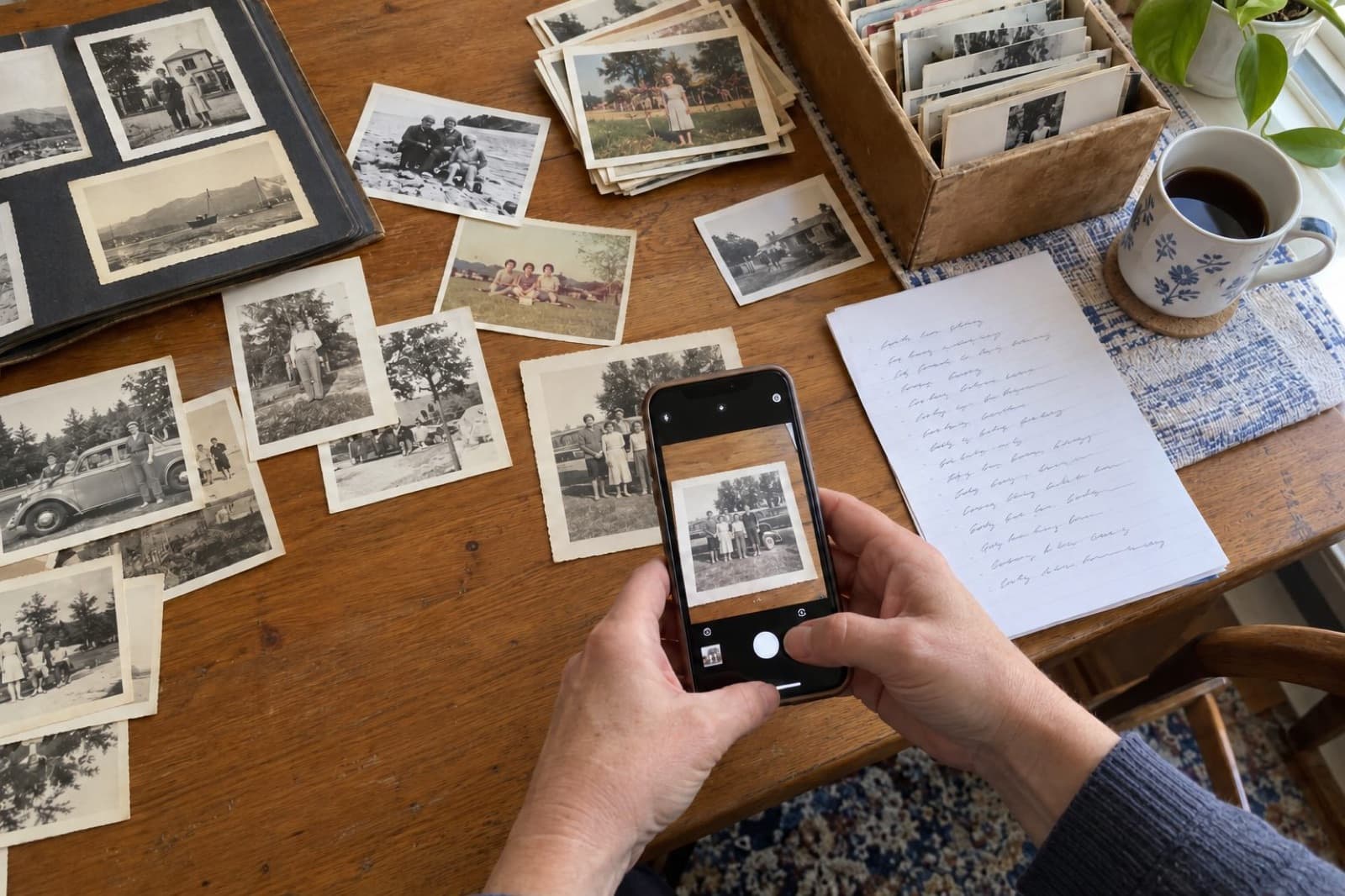
A photograph can give you both somewhere to begin. Let your parent choose one, then ask what they notice.
For an audio recording, briefly describe which picture you are discussing. Otherwise “that one” and “the person on the left” may be hard to understand later.
You could say, “We’re looking at the photograph outside the house, with four people standing by the gate.”
Afterwards, give the image a simple identifying name and use the same name in your recording notes. Keep the original safe and work from a copy when you can.
If you are in different places
Do a short technical check together before the full conversation. Confirm that you can hear each other and explain how the recording will work.
Recording options depend on the device, app, account and settings. Do not assume that a normal phone call or a screen recording will capture both sides. Test the exact arrangement you plan to use, with everyone aware that you are recording.
If it becomes complicated, keep the first conversation unrecorded and arrange a simpler method for another time. Your parent should not have to spend an afternoon troubleshooting to take part.
This guide does not recommend a particular calling app because the right choice depends on what you both use comfortably.
Finish before it becomes tiring
You might plan twenty or thirty minutes for the first conversation and carry on only if you both want to. You can return to another period of life on another day.
Before you stop, ask:
“Is there anything you would like me to leave out if I share this?”
“What would you like to talk about next time?”
Make a note of anything to remove and agree how you will handle it. Check any version you plan to share.
Save the recording while it is fresh
Give the file a descriptive name, such as “Parent-first-home-2026-10-21”. Put the person's full name in a private note if that helps your family identify it later.
Write down the date, who was speaking, the main topics and any photographs discussed. If a year or name was uncertain, record the uncertainty rather than silently resolving it.
Keep the original recording and make edits in a separate copy. Save another copy in a different location and check that it opens and plays. Do not rely solely on the only phone that holds it.
The Library of Congress recommends descriptive filenames, notes about recordings, multiple copies in different places and periodic checks that the files remain readable. Library of Congress audio-preservation guidance
You do not have to transcribe everything immediately. A short contents note can help the family find a particular story. If you later make a transcript, check names and dates against the recording, and let the speaker review anything you plan to circulate.
Questions people often ask
Do I need a special microphone?
Try your existing device first and listen to the result. If the voices remain difficult to hear after changing the position or room, consider a suitable microphone. Buying equipment before testing may solve the wrong problem.
Should I correct a memory I think is wrong?
Let the account finish. You can gently ask about the difference afterwards, or look at a document together. Keep the distinction between recollection and confirmed information clear.
Do I have to begin at the beginning?
No. A familiar place, job or photograph may be easier than a request to start with the year of birth. You can organise the material later.
Can someone else lead the conversations?
Yes. Some families enjoy doing it themselves; others would like help with the conversations and the work afterwards. The person taking part should be comfortable with whichever arrangement you choose.
Remarkable Lives makes private portraits through conversations about a person’s life, bringing their stories and family photographs together. If you would like help making one for someone in your family, you are welcome to get in touch.

Alastair is an experienced researcher and interviewer, and leads every Remarkable Lives conversation himself. He lives in Gothenburg.